

A First Encounter with Isaiah Berlin

I have been reading Isaiah Berlin lately, and I suspect he may become one of my guides for understanding our present moment — an age of ideological certainty, cultural fragmentation, and exhausted coexistence amidst difference.
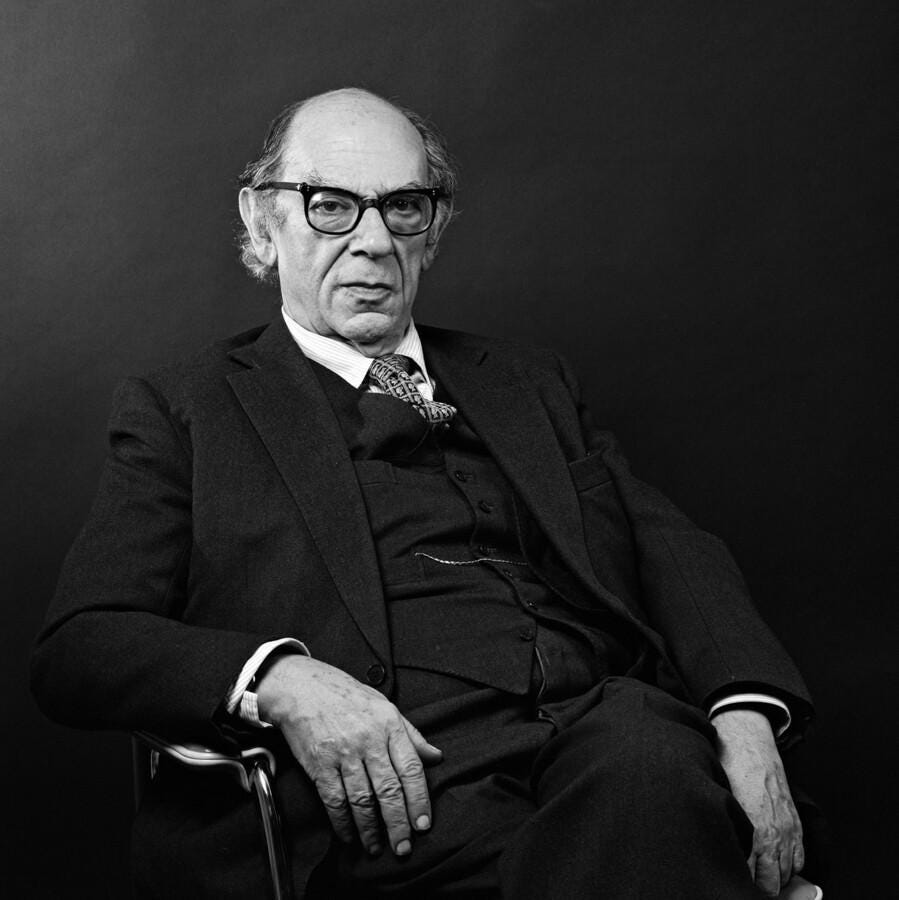
Berlin (1909–1997) was a Latvian-born British intellectual who spent most of his career at Oxford, where he became a revered figure.
I have been reading in some of Berlin’s many essay collections. This is the one on my desk right now:
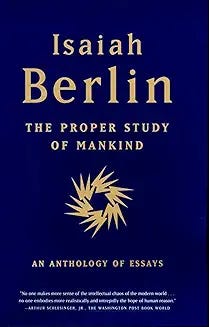
The editors of this volume offer 17 essays, in seven categories: philosophical foundations, freedom and determinism, political liberty and pluralism, history of ideas, Russian writers, romanticism and nationalism in the modern age, and twentieth-century figures (splendid contemporaneous essays on Churchill and FDR).
My best way to describe Berlin’s range is with this homely analogy: consider the Great Books collections one can still find in old sets, like the 54-volume set we have in my house. Berlin was the kind of person who would have read every one of those books and then could tell you what another 54-volume Great Books collection should cover. Berlin had mastered the European intellectual inheritance. His Russian background and linguistic facility also gave him the rather unique ability to address Russian writers in detail as well.
Berlin strikes me as a sympathetic reader. He wants to understand the person, not just the ideas. He also wants to understand the connections between ideas as they develop over time. While he was known as a political philosopher, I think he is best understood as a historian of ideas and of the figures who developed them.
His encyclopedic range is simply astonishing. I have noticed that it is still a tradition at Oxford to say of oneself as student or professor that one is “reading philosophy” or whatever subject. This reduces academia to its essential core — reading. Engaging books and ideas. How often, amid the modern bureaucracy of higher education, professors wish that they could simply read more. Berlin read philosophy, for sure, but more broadly one coud say that he read the most significant works of the European intellectual tradition, full stop.
Amid all of his reading of the history of ideas, Berlin gradually came to develop a few of his own core ideas. I want to focus on just one of them today: Berlin calls it “pluralism.” Here are two quotes from his essay “The Pursuit of the Ideal” that get at his discovery:
Machiavelli conveyed the idea of two incompatible outlooks; and here were societies the cultures of which were shaped by values, not means to ends but ultimate ends, ends in themselves, which differed, not in all respects — for they were all human —but in some profound, irreconcilable ways, not combinable in any final synthesis…
Herder’s view, and Vico’s is…what I should describe as pluralism — that is, the conception that there are many different ends that men may seek and still be fully rational, fully men, capable of understanding each other and sympathising and deriving light from each other..
Forms of life differ. Ends, moral principles, are many. But not infinitely many: they must be within the human horizon.
Berlin, whose life had been uprooted by revolution and spanned the rise of Communism, Fascism, two world wars, the Holocaust, and a Cold War, became a skeptic of all "final solutions,” all ideological schemes to perfect the world, all pursuits of a monistic envisioned ideal, especially where (as so often) government coercion at gunpoint is deployed in said pursuits.
Berlin came to believe that Western civilization had mistakenly assumed there was one final human good, one ultimate value around which all rational people would eventually converge. History taught him otherwise. In actual reality humans are pluralistic both individually and culturally in how they look at the world and what they ultimately value. This must simply be accepted. Much violence has been done, literally and metaphorically, in the refusal to accept it, whether in Christendom or modern politics. Authoritarianism can be secular or religious but either way is often rooted in a posited authoritative ultimate end to which the central power expects all to adhere.
Life together in human community requires acknowledging the range of principles by which people and societies live, the range of values they pursue, the range of goods they seek. It also means accepting that some of these are not just temporarily in conflict but permanently irreconcilable. And thus life in community involves negotiating unyielding differences and finding tolerable tradeoffs and temporary accommodations.
This has profound implications for all polities, all communities. It speaks to church life, where so often our discovery of conflicting values, principles, goals, or beliefs shatters community and sends fragments off to form new communities where the inevitable eventually happens once again.
It also speaks to political life. In the US right now, our left/right binary is so strong, and involves so many conflicting values, which each side so often considers non-negotiable. We rub up against each other like tectonic plates, finding it intolerable to have to share a nation with people who think and live so differently than we do.
In a time when so many people demand total ideological victory, Berlin reminds us that democratic and communal life depend instead on the difficult art of coexistence amid irreducible difference. That may be one of the essential lessons of our age.
Isaiah Berlin is a tonic for these times. I plan to keep reading him, closely.