

‘I Wanted People to Know They Were Not Abandoned’: A Conversation with Logan Morrison
A former evangelical college soccer coach reflects on transition, ministry, spiritual care, and serving trans Christians in a fearful political moment.


Note: Nearly three years ago I interviewed Kelsey Morrison, who had made national headlines as she was forced out of her soccer coaching job at her evangelical college for open communication related to her sexual orientation. This week we followed up. Our conversation was illuminating and inspiring. But also maddening, because of the suffering we, mainly Christians, continue to inflict on some of our most vulnerable young neighbors.
DG: The last time we spoke, you had been forced out of your coaching job at Geneva College based on your sexual orientation. Tell us the next steps in your journey?
LM: The next steps were ones of learning to mourn and learning to accept help. Unbeknownst to me, God had been helping me learn to build community the prior year so that I had incredible people to fall back on to support me and step in as family.
After losing my job coaching soccer at Geneva College I felt that continuing to coach was my calling. I applied for many jobs and got offered rather quickly an opportunity at a college in rural upstate New York.
Leaving western Pennsylvania and my community that I had finally learned to build was the hardest thing I had been through in my adult life, but I had a theory at the time (that I now question the validity of) that God has called me to do hard things. And I am supposed to do the hardest things I can no matter what. So, less than two months after losing my job and coming out as queer in a very public way I was moving across the region and stepping into another university setting.
Moving on proved to be very difficult and I had to balance very carefully what it meant to mourn loss, take on a new task, and ultimately allow myself to love and engage with this work again.
Throughout the next year of coaching I was facing my own journey of depression as I wrestled through another major step in my life — coming out as Transgender. During that time I was able to trust the clarity God had given me and build support around me so I could come out and begin transitioning in my workplace, socially, and medically.
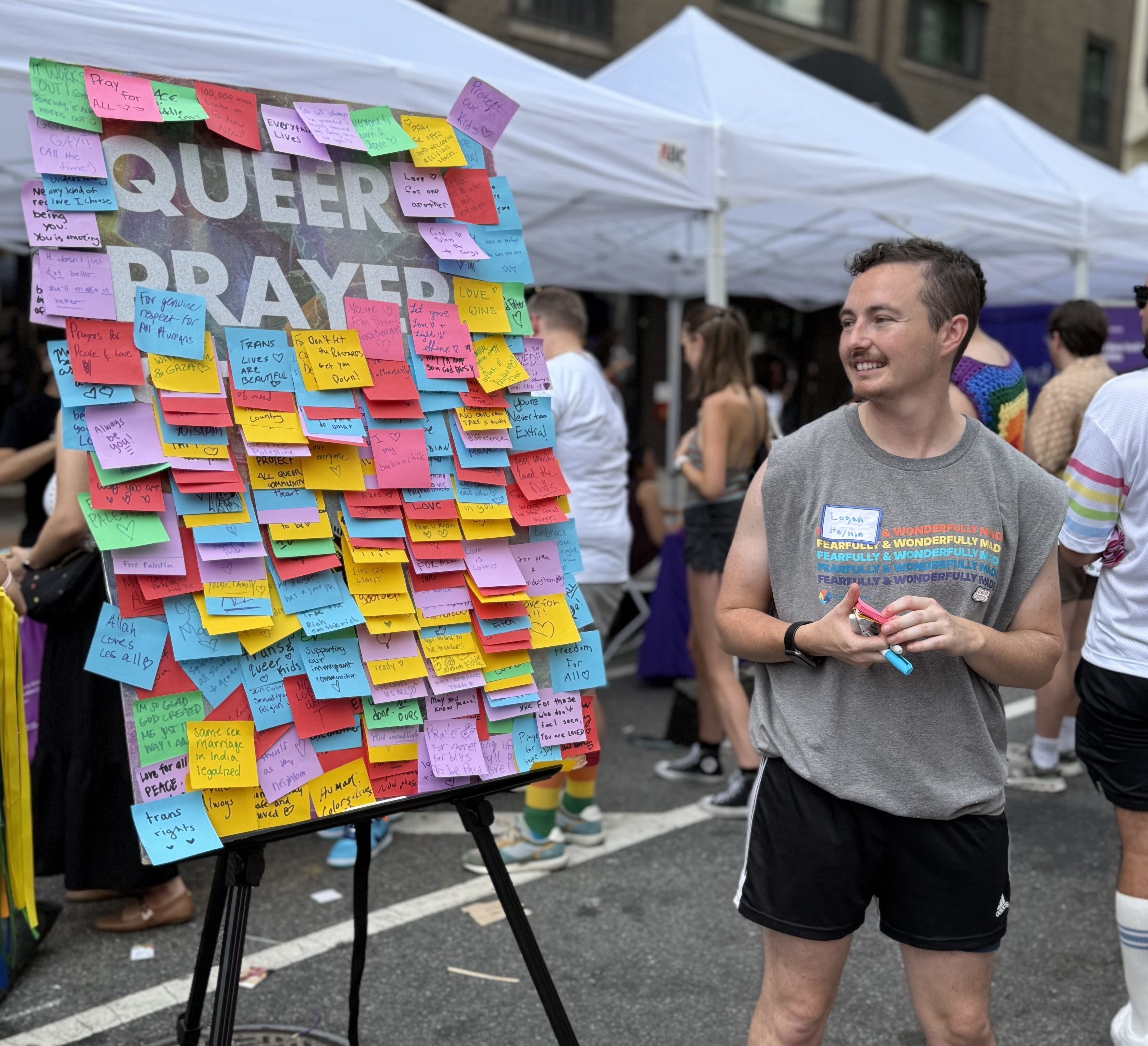
—Photo: Logan Morrison, provided by Logan.
I knew this decision would mean losing a lot of people in my life — and it did. What I didn’t expect was the community I gained and the purposes that God had for my journey — not just for personal survival, but for something much grander in God’s kingdom building plans.
DG: When did you join Kaleidoscope ministry? What led you to this step?
LM: I joined Kaleidoscope first in January of 2025 as an intern and later in March of 2025 stepped into a missional role as Trans Ministry Specialist and Community Outreach Coordinator and began raising funds for the expansion of Trans ministry.
This all began as a step I stumbled into rather than a step I took. In the fall of 2024 I was entering into a new semester having recently come out as “Logan” and beginning medical transition. Parents of students began to file complaints of being uncomfortable around me which quickly led to a loss of employment again and a deja vu moment.
I grew up thinking that if you work hard and do your best that that was all you needed. But I was learning about discrimination. As a Christian, white-majority growing up, I had only heard of discrimination in theory, and had sparsely experienced it. Now, I could understand more of what that experience was. I had faced it myself.
Discrimination brought me to NYC where I found my chosen family and began serving with them at Kaleidoscope and becoming a recipient of care from this organization.
If there was one thing other than misfortune that led me to Kaleidoscope, it was a word a college student spoke to me after a scrimmage in the fall of 2024 before my loss of employment. After a scrimmage a student-athlete from the other team came up to me and shared “thank you for being visible. I’ve never seen someone like you coaching soccer. I am non-binary and want to coach one day and it means a lot to be able to see you in this role and see someone like me for the first time.”
Wow. At that point I had done nothing except chosen to make one honest choice, and because of that people felt cared for. That was the first positive fruit I saw from my transness and that helped me begin to imagine that this was something God was in the business of using.
DG: What are the major needs of the trans community that you work with? What ministry goals and strategies are you pursuing?
LM; Going from living in a place where I knew one other trans person to being in NYC where there is the highest concentration of trans people in the U.S. (50,000, still just 1% of the population of NYC despite contrary media opinions). That gave me my own version of immersion.
At Kaleidoscope, we place our mission work around the priority of contextualization. That is one reason why all our staff identify as Christians and LGBTQ+. The needs of trans folks are little different from those of marginalized people across our whole country — safety, healthcare, community, and belonging.
But one thing that often gets overlooked is spiritual care. Many trans people are carrying the constant burden of explaining themselves, defending themselves, or surviving systems that were not built with them in mind. Additionally, over 66% of trans-identifying people grew up actively participating in religious environments. When we talk about trans folks and we talk about the church, much of the language is synonymous. It is the bride of Christ talking about herself and oftentimes criticizing her own physique.
Many trans people are carrying deep wounds connected to Christianity. A large part of our ministry is simply rebuilding trust: helping people encounter Christians who are safe, honest, and willing to listen. I work to pursue ministry goals of mutuality. As I experience life with the trans community I get to learn more about God and who He is.
My work with Kaleidoscope ranges from direct pastoral care and discipleship to community organizing, trans pastoral care training, and creating spaces where trans Christians can explore faith without fear.
DG: How has life for the community you work with changed since Trump assumed the presidency for the second time? How has your ministry responded?
LM: The political climate has increased fear and uncertainty for many trans people. Even beyond specific policies, the constant public debate around trans existence creates exhaustion and anxiety. Many people in our community are asking basic questions about safety, healthcare access, employment, and whether they are seen by others or even by God.
What has struck me most during Trump’s second presidency is how quickly political rhetoric filters down into everyday interactions. When public leaders speak about trans people as threats or problems, it gives permission for fear and hostility to grow in ordinary spaces like in the local government, workplaces, and families. Many trans people feel increasingly isolated and spiritually abandoned. I have seen that in my own life and the lives of dozens of trans adults who want to experience God so badly.
At the same time, this moment has made the importance of outreach and presence even clearer to us. Our ministry has responded by becoming more visible, relational, and intentional in sharing the Gospel with people through tangible acts. Many TGNC (Transgender and Gender Nonconforming) people have never encountered a trans Christian who wants them to know they belong in the kingdom of God. It is an honor whenever I get to be used as a representative in that way
We believe the Gospel is fundamentally good news, especially for people who have been pushed to the margins. So our response has been to show up consistently: building relationships, creating spaces of belonging, discipling people, and reminding the trans community that they are seen and loved by God.
In many ways, the harder the cultural moment becomes, the more important it is for us to embody hope, compassion, and presence. We want trans people to know that God has not forgotten them, and that there are Christians committed to walking alongside them with loyalty and love.
DG: What are the next steps for you and Kaleidoscope? What are you dreaming?
LM: Personally, I feel increasingly called toward mission work that begins with proximity to people who are hurting and pushed to the margins. As a trans man, I know what it feels like to lose community, stability, and a sense of safety almost overnight. I know what it feels like to wonder if being honest about yourself will cost you your livelihood, your relationships, or your place in Christian spaces. Because of that, ministry has become very tangible to me.
When I think about sharing the Gospel now, I think less about winning arguments and more about showing people they are not abandoned. I think about helping someone find housing, sitting with someone after they’ve been rejected by family, helping a young trans person imagine a future for themselves, or creating spaces where people can breathe for the first time in a long time.
At Kaleidoscope, we want to keep building a ministry that meets both spiritual and practical needs. That includes mentorship, pastoral care, community support, leadership development, and simply being consistently present in people’s lives. A lot of LGBTQ+ people, especially trans people, have only experienced Christianity at a distance or through condemnation. One of my hopes is that through relationships and service, people encounter Christians who look just like them, willing to listen, stay, and love well.
I also care deeply about visibility and outreach because visibility changed my life. Before I transitioned, I genuinely did not know trans Christians existed in meaningful numbers, much less trans people in ministry leadership. Now I meet younger trans people who are trying to imagine whether they have a future in the Church, in ministry, or even in the world at all. I want my life and work to help answer that question with hope.
DG: How can people support your work?
LM: People can support our work financially by investing in Kaleidoscope, because so much of this ministry involves direct care, discipleship, mentoring, outreach, and community building that often happens quietly and behind the scenes. Financial support helps us continue creating spaces where trans people can encounter both tangible care and the love of Jesus.
Another meaningful way people can support this work is through visibility. When Christians publicly communicate that trans people are loved by God and worthy of dignity, belonging, and spiritual care, it has a profound impact. For many trans people, simply seeing someone speak with compassion and conviction can begin rebuilding trust that was lost through painful experiences with the Church.
More than anything, I hope people understand that this ministry is ultimately about reflecting Christ well. Jesus consistently moved toward people who felt abandoned, misunderstood, or pushed to the margins. Supporting this work means helping us continue that same ministry of presence, compassion, and hope. Below are some ways that you can take action if you are a person of faith hoping to give back to the trans or greater LGB+ community:
https://secure.qgiv.com/for/transministryfund/
https://www.kaleidoscopeusa.org/
https://www.kaleidoscopeusa.org/trans-resources
https://www.kaleidoscopeusa.org/allies
DG: Any final words for my readers?
LM: I think many Christians have been taught to approach trans people first as a theological debate rather than as neighbors, image-bearers, or fellow disciples. But relationships change people. Presence changes people.
My hope is that readers would become more curious. Throughout Scripture, God consistently meets people in places that challenge existing categories and expectations. I do not believe trans people are outside of that story.
I also want readers to remember the good news of the Gospel, receive it for themselves, and consider how they can share it with others tangibly in their own ministry context.
And for any trans reader who may come across this interview: your existence is not a mistake, and your story may become a source of life for someone else someday.
Thank you for this 👍